Two real estate sites pulled numbers for the same patch of South Philadelphia within the past year. One said the median sale price was $700,000. The other said $500,000. Both were current when published. Both were labeled Bella Vista. Neither was wrong.
The gap has nothing to do with a hot streak or a cooling market. It comes down to a line on a map, and once you understand where that line gets drawn, you start to see why a single median for Bella Vista was never going to tell you much in the first place. This is a neighborhood where the number depends on the boundary, and inside any boundary, on the block and the housing type. If you are comparing Bella Vista to Queen Village or Passyunk Square while shopping by median price alone, you are comparing numbers that were built to disagree.
Two Boundaries, Two Bella Vistas
Here is the actual math behind that $200,000 gap. One data provider's tighter "Bella Vista" polygon reported a median sale price of $700,000 in October 2025, up 40 percent year over year, drawn from just 16 closed sales that month. A wider polygon, "Bella Vista-Southwark," which folds in more of the surrounding blocks, reported a median of $500,000 for the three months ending May 2026, up a steadier 11.5 percent year over year, on 144 sales.
Different months, yes. But a six-month swing does not explain a $200,000 difference on its own, and the sample sizes tell the real story. Sixteen sales is small enough that two or three high-end closings on Christian Street can drag a median up by six figures. A hundred and forty-four sales is a large enough pool that outliers get absorbed. So when you see "Bella Vista's median is $X" on any given site, the honest next question is not whether the number is accurate. It is which addresses were counted to get there.
As of late August 2026, one current market snapshot showed roughly a dozen and a half active Bella Vista listings, with a median list price near $460,000 and an average days-on-market figure well past 150. That is a thin, patient market by Philadelphia standards. Thin markets are exactly where boundary choices matter most, because there are not enough transactions to smooth out the noise.
What a Single Median Actually Hides
Set the boundary question aside for a moment. Even within one consistent definition of Bella Vista, the housing stock itself splits into two markets that shouldn't be averaged together any more than a studio and a five-bedroom house should.
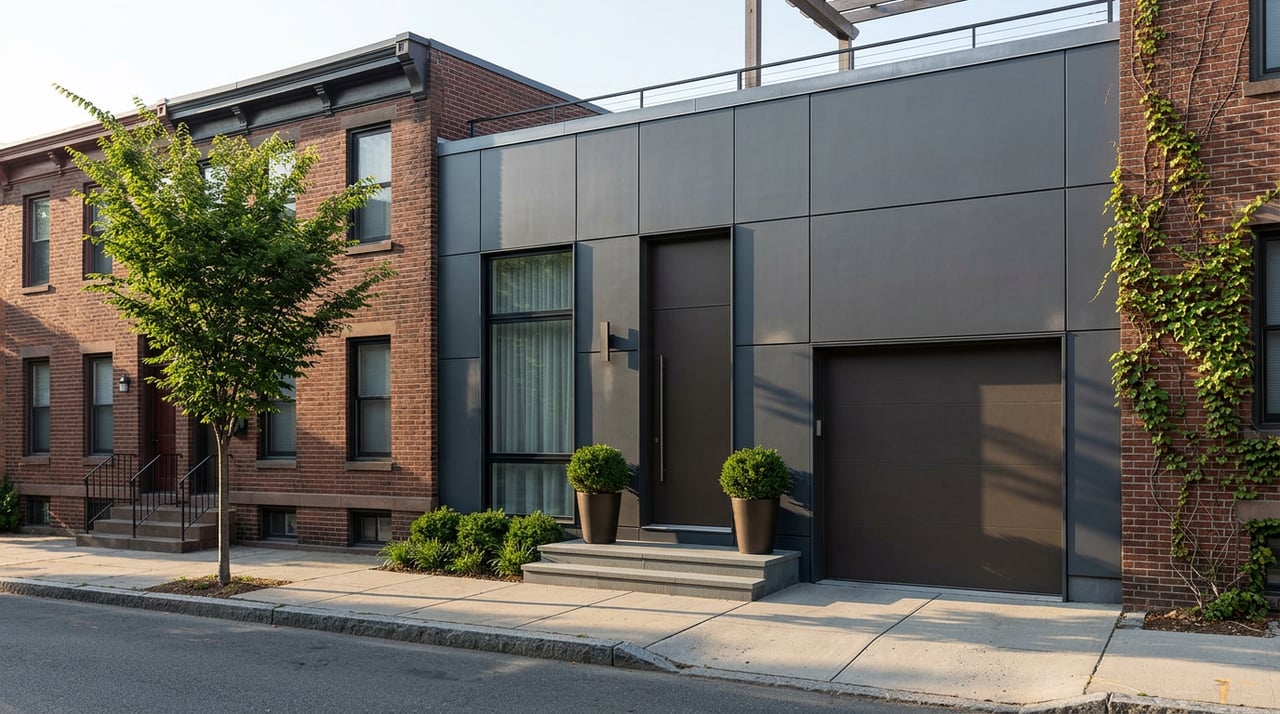
At one end are the Trinity houses: three-story rowhomes with one room per floor, a housing type that dates to Bella Vista's earliest development on its narrower interior streets. They sit at the low end of the neighborhood's rowhome range. At the other end sits new construction like 10 on Eleventh, a Hightop-developed community at Christian and 11th Streets built around a very different buyer: units over 3,200 square feet with four bedrooms, four full and two half baths, two-car garage parking, a residential elevator, and a private rooftop deck. Phase one of that project sold out entirely, and only a handful of homes remained as of this research.
Here is roughly how the price bands stack up across housing types in Bella Vista right now, with the overall neighborhood median sitting in the low $500,000s:
| Housing type | Typical price range |
|---|---|
| Rowhome (spans Trinity houses through fully renovated standards) | Mid-$300s to high $800s |
| Condo, including loft conversions like Bella Vista Lofts and Fitzwater Lofts | Mid-$400s to high $600s |
| Newer townhouse, standard new construction | Upper $400s to $1M+ |
| Garage-and-elevator new construction (10 on Eleventh type) | Top of the market, above the standard new-construction ceiling |
A median sits somewhere in the middle of that table and describes none of it accurately. It is not that the median is calculated wrong. It is that averaging a Trinity house at the bottom of the rowhome range with an elevator townhome at the top of the new-construction range produces a number that no actual buyer is shopping for.
A Corner Lot Explains the Rest
If you want to see why block matters as much as housing type, look at the triangle lot at 601 Christian Street. It sat vacant for years, a former gas station with real environmental remediation costs attached, and Bella Vista's own zoning committee spent real meeting time on what would replace it. The city made clear early on it had no interest in buying the site for parkland, so the actual question on the table was never park versus building. It was what kind of building: mixed-use with ground-floor retail that keeps the Passyunk Avenue corridor active at street level, or something less integrated with the sidewalk.
That fight matters to a buyer for a reason that has nothing to do with nostalgia for one gas station lot. It is a useful example of how much of a Bella Vista block's future value gets decided in a rec center meeting room, not baked into a fixed zoning code. A block that looks settled on a listing photo may have a pending decision that changes its retail mix, its foot traffic, or its parking within a year or two. The Bella Vista Neighbors Association runs an active zoning committee for exactly this reason, and its meeting notices are public. Anyone seriously comparing two blocks in the neighborhood should know whether either one has something pending.
What This Means If You're Comparing Neighborhoods
Bella Vista is bounded by 6th Street, 11th Street, South Street, and Washington Avenue, and it borders Queen Village closely enough that some listings get marketed as sitting on the line between the two. Both neighborhoods draw on the same general school catchments in parts, with students zoned to William M. Meredith School or George W. Nebinger School before Furness High School. If you are cross-shopping the two, the practical difference usually shows up less in the school assignment and more in inventory type: Queen Village has historically leaned toward slightly more consistent rowhome stock, while Bella Vista's spread between Trinity houses and new luxury construction is wider.
The same logic applies to comparing Bella Vista against Passyunk Square to the south. A citywide portal will hand you a single median for each and imply an apples-to-apples comparison. What you actually need to know is what's for sale on the specific blocks you'd consider, not what the polygon-wide average says this month.
Reading a Bella Vista Listing Like Someone Who Knows the Blocks
Once you accept that the median is a starting point and not an answer, the checklist for evaluating an actual listing gets shorter and more useful:
- Is this a Trinity house, a standard rowhome, a loft conversion, or new construction? Each has its own price logic, and the four shouldn't be compared against each other on price per square foot alone.
- Off-street parking or street parking only? Older rowhomes typically rely on street parking, while newer builds increasingly include a garage, and that single feature moves price more than most cosmetic upgrades.
- Interior street or a Christian/Catharine-corridor block near the Italian Market and its anchors like Di Bruno Bros. and Isgro Pastries? Proximity to the 9th Street corridor carries its own premium separate from housing type.
- Is there a pending zoning matter on the block or the block adjacent? Check the Bella Vista Neighbors Association's zoning updates before assuming a quiet block stays quiet.
- Which portal boundary is being used to describe "comparable sales"? If a comp set includes Bella Vista-Southwark addresses, ask whether those comps are genuinely comparable to the specific block you're considering.
FAQ
Is Bella Vista's real median price closer to $500,000 or $700,000? Neither number stands alone. The $500,000 figure comes from a wider boundary with a much larger sample of sales, which makes it more stable. The $700,000 figure reflects a tighter boundary and a small sample where a few high-end sales can swing the result. Treat the wider, larger-sample number as the more reliable baseline, and treat both as context rather than a price target for any specific home.
Is new construction still available in Bella Vista, or is it mostly renovated older housing? Both exist side by side. Renovated Trinity houses and standard rowhomes make up most of the resale inventory, while projects like 10 on Eleventh show that ground-up new construction, including garage parking and elevators, continues to get built and sell out in the neighborhood.
Does Bella Vista compare more closely to Queen Village or to Passyunk Square? It sits geographically and functionally between the two, sharing some school catchment overlap with Queen Village and a similar rowhome-heavy stock with Passyunk Square. The better comparison isn't neighborhood versus neighborhood but block versus block, since housing type varies more within Bella Vista than the neighborhood-level averages suggest.
If you're trying to figure out what a specific Bella Vista block or housing type is actually worth before you write an offer, Reid Rosenthal and The Rosenthal Group can walk you through the real comps, not the polygon-wide average. Schedule a Free Consultation to get a block-level read before you rely on a single median.